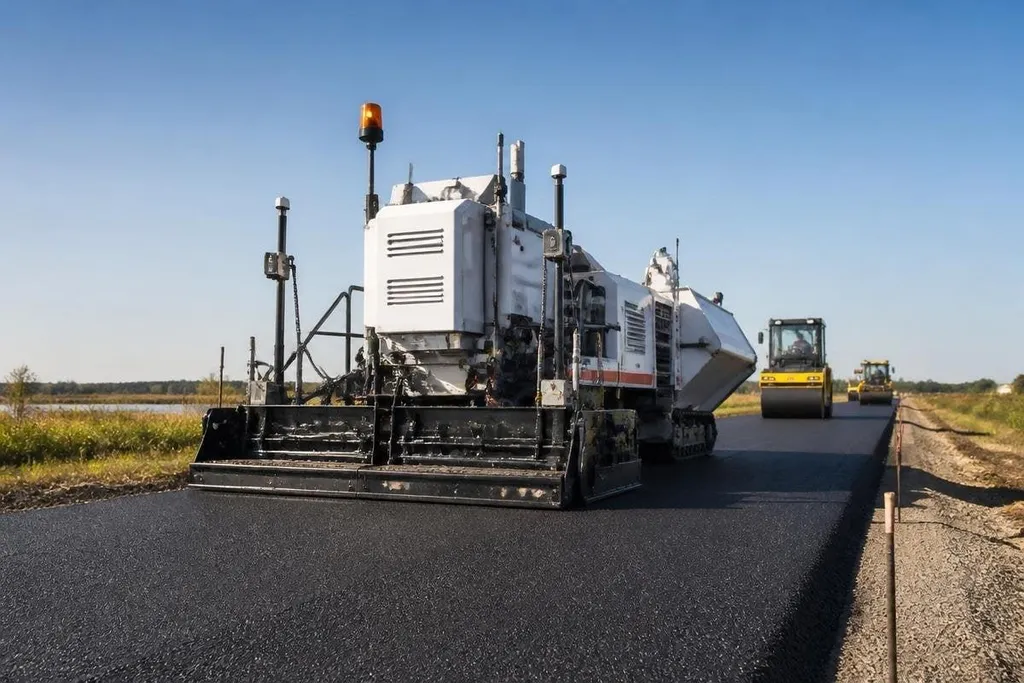
Road-paving robots are being discussed as a way to handle repeated work around asphalt, concrete, and road repairs. The public evidence supplied for this article includes no named companies, field trials, prices, dates, or test results, so the rise is easier to describe as a direction than a measured market trend.
- The task: paving needs steady movement, accurate placement, and control of material flow.
- The limit: no supplied source proves that road-paving robots are working on public roads at useful scale.
- The buying test: a real job site matters more than a short video.
Why roadwork attracts robot builders
Road paving has a clear set of repeated actions. A machine may need to move along a planned path, keep a set speed, place material across a defined width, and work beside other equipment. Those tasks are easier to describe in software than many jobs that change from one second to the next.
That does not make them easy. Roads vary in width, slope, surface condition, traffic control, weather, and material temperature. A robot that works on a closed test area may face a different problem beside live traffic or on a surface that was prepared by another crew.
The useful question is not whether a robot can move over asphalt. It is whether the robot can keep the required position and speed while the site changes around it.
What the robot would have to control
A road-paving system would need sensors that measure its position, nearby workers, vehicles, and the surface ahead. It would also need a control system that turns those measurements into safe movement.
Position errors matter because a small drift repeated across a long lane can change the finished width. Material handling adds another test. Asphalt temperature, flow rate, layer thickness, and compaction affect the finished road.
The system may move well and still produce poor work if it cannot check the material as it leaves the machine or after it reaches the surface. It also needs a safe response to faults.
A blocked sensor, lost position signal, stopped conveyor, or person entering the work area must lead to a controlled stop. Road crews need to know who can restart the robot and how long that process takes.
Where the value could appear
The strongest case would be work that keeps people away from traffic, dust, heat, or long periods of repeated movement. A robot could also help keep motion steady during a task where changes in speed or position affect the finished surface.
Those gains depend on the full work site. If a crew member must guide the robot at every turn, check its position by hand, and stop the system often, the robot may add another task instead of removing one. Labor savings need proof from the whole crew, not a claim about the robot alone.
A road-paving trial still needs the road length, paving speed, crew size, and repair record. Robot24.com can place those details beside the machine and company named in the trial, giving you a record to test before asking what remains unproven.
What is still unproven
No evidence pack was supplied here to confirm a road-paving robot’s payload, working speed, position accuracy, runtime, weather rating, or cost. Those missing figures matter because road work is paid by completed area, lane, or project, not by time spent in a demonstration.
A serious trial would need a named site, a clear task, and a record of the result. It should state how much road the system completed, how often a person took control, how many stops occurred, and whether the finished surface passed the same checks used for regular work.
I’d wait for those records before calling road-paving robots a rising market.
A buyer’s check before a pilot
Use these points when a supplier presents a paving robot:
- Name the task: specify the material, road section, layer, and work step.
- Set the measure: record lane width, thickness, speed, position error, and completed area.
- Count human input: log every manual correction, restart, and safety stop.
- Check the site: test slopes, dust, heat, poor markings, and nearby vehicles.
- Price the whole job: include setup, supervision, transport, repairs, and crew time.
- Verify the result: compare the finished road with the project’s normal inspection tests.
Those checks turn a broad claim into a job record. They also show where a robot helps, where it needs a person, and where the cost still sits.
The next useful proof is a dated field trial with measured output and manual interventions. Until that appears, road-paving robots are a credible work target, not a proven change to road construction.